How to Become a Travel Agent Without Experience, Step by Step
You can become a travel agent without experience, and most people do. There is no federal license, and only a few states require a seller-of-travel registration. The usual route is to pick a niche, join a host agency, register the business, arrange insurance, set your fees and tell the people you know. Quoting can start within a month, though being paid takes longer.
That short answer hides the part that decides whether it works. Experience matters less in this job than order. New advisors who do a small number of things in the right sequence get their first bookings sooner than those who do a large number of things at random.
What no experience really means in travel
Almost nobody arrives in this work from inside the industry. People come from teaching, nursing, retail, office administration and the military, and they bring skills that carry straight across. Listening, planning to a deadline, handling money carefully and staying calm with an upset customer are most of the job.
The federal government's own description backs this up. O*NET's profile of travel agents describes the work as planning and selling transportation and accommodation, working out costs and itineraries, and resolving clients' travel problems. None of that requires a degree or a past job at an agency.
It is also a common second career. Across the students we work with at the Travel Advisor Academy, roughly half have come to travel advising after fifty, a share that has held steady over the past two years. Many already have a network of friends who travel, and that network is where the first bookings come from.
What a beginner lacks is narrower than it sounds. It is supplier knowledge, booking systems and the habit of pricing every trip before quoting it. All three can be learned, and a host agency supplies the first two on day one.
The steps to become a travel agent without experience
The sequence below is the one that tends to work for someone starting from nothing. Each step hands something to the next, so skipping ahead usually means coming back to redo an earlier one.
- 1
Choose a niche
A destination, trip type or kind of traveler you can learn properly.
Hands on the suppliers worth knowing - 2
Join a host agency
Pick one that serves your niche and explains its commission split clearly.
Hands on accreditation and supplier access - 3
Register the business
A business name, a bank account and the structure that suits you.
Hands on a name suppliers can pay - 4
Check state rules and insure
Confirm any seller-of-travel registration and arrange errors and omissions cover.
Hands on permission to take money - 5
Set your fees
Decide what you charge for planning before anyone asks.
Hands on a price you can say out loud - 6
Tell your network
One clear announcement of exactly what you now do and for whom.
The full guide to how to become a travel agent covers each of these in depth, with a startup cost calculator and a 30-day plan. What follows here is the part a beginner most often gets wrong in each step.
Register before you take a single inquiry
A business name, a bank account and the right insurance are a weekend of work. They are what turn this from a favor for friends into a business. Doing them after the first booking means unpicking a reservation made in the wrong name.
Errors and omissions insurance deserves a sentence of its own. It covers the advice you give, which is the thing a travel agent actually sells, and it is different from general liability cover. Many host agencies include it, so ask before you buy a separate policy.
Pick one thing to be good at
The advisors who struggle are the ones who will book anything for anyone. The ones who do well pick a lane, learn it properly and become the obvious person to ask. It does not have to be glamorous. It has to be specific, as the guide to choosing a travel niche explains.
Theme parks are a common first niche for exactly this reason. The route into becoming a Disney travel agent runs through a host agency and free supplier training, which suits someone with no background at all.
Licensing rules to check before your first booking
There is no federal license for travel agents in the United States. What exists instead is state seller-of-travel law, which requires registration from anyone selling travel to that state's residents, wherever the seller is based. Four states run active programs.
- California requires registration and participation in a restitution fund. The California travel agent guide covers it.
- Florida requires registration with the Florida Department of Agriculture and Consumer Services, renewed each year. See the Florida travel agent guide.
- Washington requires registration through the Washington State Department of Licensing.
- Hawaii requires registration for travel agencies selling to its residents.
Iowa used to be on that list and repealed its law in 2020. Most other states, including Texas, Georgia and New York, have no seller-of-travel registration at all, so a business registration and insurance are enough to start.
In practice, many host agencies hold these registrations and cover their affiliated advisors. Get that confirmation in writing before you sell to a client in a registration state, and check the state's own site for current rules, because fees and forms change.
Why most beginners start with a host agency
A host agency is a larger agency that lets independent advisors book under its accreditation, contracts and insurance in return for a share of commission. For someone with no experience, that is most of a business on the first day.
Going independent means applying for your own accreditation and building every supplier relationship from nothing. That pays more per booking later, but it is slow, and it asks a beginner to make decisions they do not yet have the knowledge to make. The comparison of a host agency or going independent sets out when the switch starts to make sense.
Choosing a host is a real decision, not a formality. The questions worth asking first are short.
- What share of commission do you keep, and is there a monthly fee?
- Which suppliers are preferred, and do they fit your niche?
- What training and support exist when a client is stranded?
- Do your clients stay yours if you leave?
What the first three months usually look like
Expect the first booking to take weeks rather than days. The first inquiry nearly always comes from somebody who already knows you, and the first booking from a stranger takes longer. Planning for a quiet first month means it will not surprise you.
The money lags further still. Suppliers pay commission after the client travels, so a trip booked in month two for travel in month eight pays in month nine. That is why a planning fee matters from the first client, since it pays for the work in the months when nothing has traveled yet.
The guide to finding your first ten travel clients covers where those early bookings come from and how to turn them into repeat business.
How the course takes a beginner from zero to booking
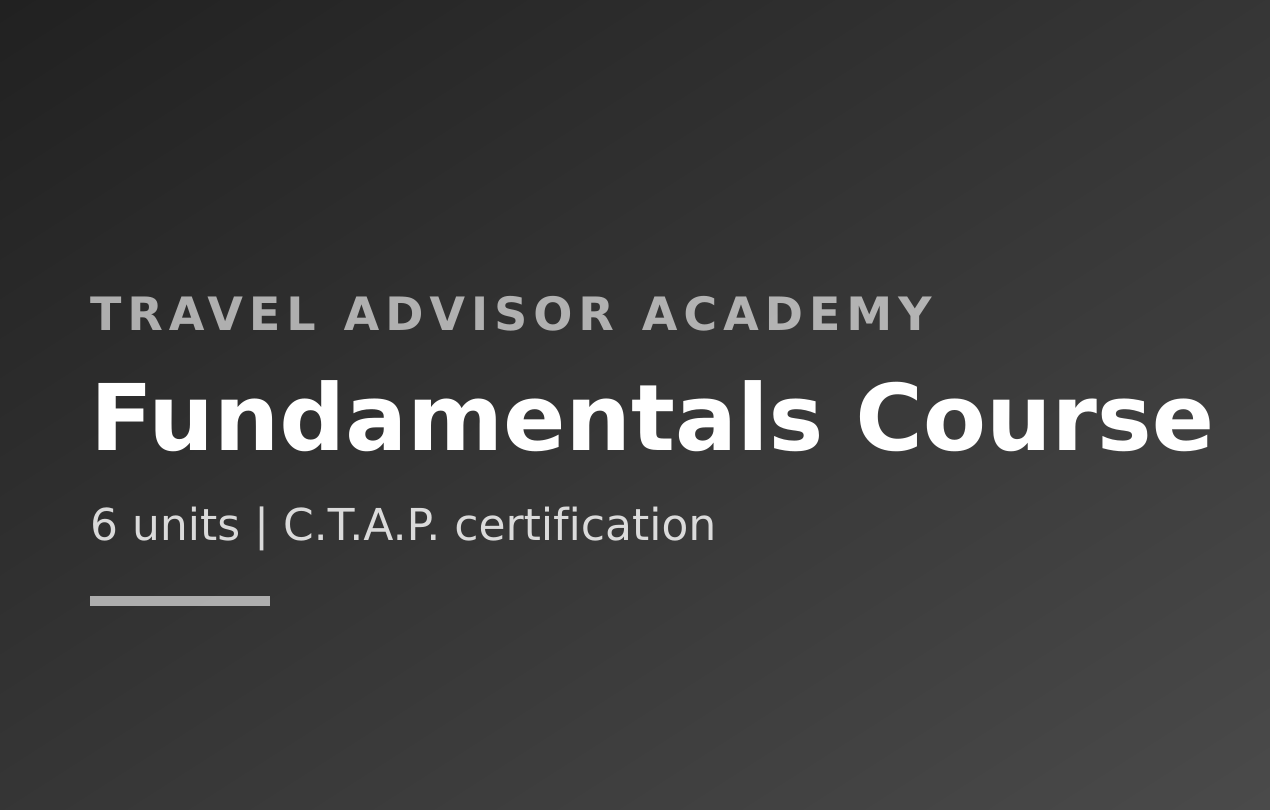
The Fundamentals Course follows the same order as this post. Unit 1, The Travel Advisor Profession Today, covers what an advisor is paid for and a realistic launch budget. Unit 2, Setting Up Your Travel Business, covers registration, insurance, seller-of-travel rules and the host agency decision on real numbers.
Units 3 to 6 then cover commission and fees, suppliers, itinerary design and finding your first clients. The course ends with an online exam for the Certified Travel Advisor Professional (C.T.A.P.) credential, which gives a newcomer something concrete to show the first clients who ask about training.
Ready to get started?
Our step-by-step courses take you from where you are now to a credential you can show, with templates, an online exam, and a 30-day money-back guarantee.
See the courses